Back to all posts
Oct 24, 2026
From Cyberattacks to Cyber Resilience: Why VAPT and Compliance Matter More Than Ever

Prithvik S.L
Security Engineer
How PHP2Shell, eMudhra and LiteLLM highlight AI-assisted exploitation, security weaknesses and business resilience.
The cybersecurity landscape is entering a new phase. Artificial intelligence is accelerating vulnerability discovery and exploit development, while weaknesses in applications, cryptographic infrastructure and AI systems continue to pose risks.
Incidents such as PHP2Shell, eMudhra and LiteLLM highlight the need for VAPT, timely remediation, incident response and compliance assessments. Combining these practices with ISO 27001 and SOC 2 helps organizations strengthen security controls, improve recovery readiness and build cyber resilience.
1. The Evolving Cyber Threat Landscape: Lessons from PHP2Shell, eMudhra and LiteLLM
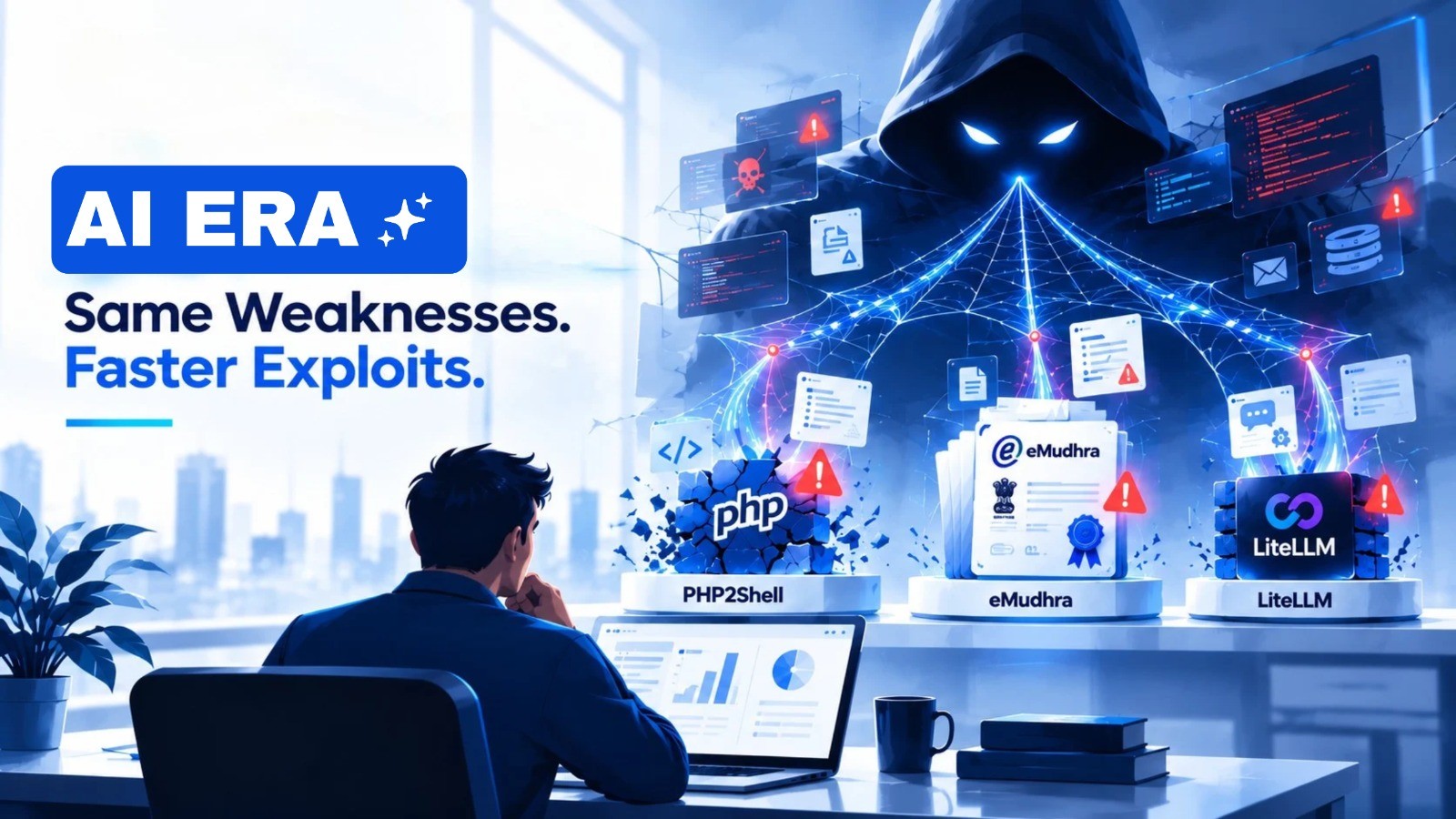
Traditional security problems—including outdated software, weak access controls, insecure configurations and poor cryptographic practices—remain relevant. AI-assisted analysis can make some weaknesses easier to investigate and exploit, increasing the importance of timely validation and remediation.
At a glance
Incident | Primary failure | Potential risk | Defensive priority |
|---|---|---|---|
PHP CVE-2026-109618 / CVE-2026-109619 | Runtime memory safety | Potential remote code execution under affected conditions | Patch, redeploy, verify runtime and investigate telemetry |
eMudhra certificate incident | Weak key generation | Potential fraudulent certificate issuance if keys are recovered and abused | Validate keys, revoke affected certificates, manage trust changes |
LiteLLM supply-chain incident | Developer identity / release integrity | Credential theft and malicious code execution in affected environments | Contain, rotate secrets, investigate, rebuild from verified artifacts |
PHP2Shell: AI-Assisted Vulnerability Discovery and Exploitation:
What: Two critical PHP runtime vulnerabilities, CVE-2026-109618 and CVE-2026-109619, enable potential remote code execution.
Exploit: An unauthenticated attacker may exploit memory corruption or stale global state in vulnerable PHP workers to execute code.
Impact: Compromise of the affected server and potentially its applications or sensitive data.
Remediation: Upgrade to a fixed PHP version: 8.5.12, 8.4.27, 8.3.36 or 8.2.35, as applicable.
Learning: Maintain software inventories, prioritize critical vulnerabilities, conduct VAPT and monitor suspicious activity.
Source: Bitdefender's PHP2Shell technical advisory.
eMudhra: When a Cryptographic Weakness Challenges Digital Trust
What: Eight eMudhra intermediate CA certificates were affected by insufficiently random cryptographic key generation.
Exploit: Attackers could potentially recover private keys and issue fraudulent trusted certificates.
Impact: Potential website impersonation, man-in-the-middle attacks and interception of communications.
Remediation: Revoke affected certificates, update trust stores and apply relevant vendor security updates.
Learning: Validate cryptographic implementations, audit certificate dependencies and prepare emergency certificate-replacement procedures.
Sources: CERT-In advisory and eMudhra's incident statement.
LiteLLM: Securing the Infrastructure Behind AI Applications
What: LiteLLM vulnerabilities CVE-2026-35029 and CVE-2026-59823 affected access control and outbound request handling.
Exploit: A low-privileged user could potentially access administrative functions or redirect requests to expose AI-provider API keys.
Impact: Potential gateway takeover, credential theft, unauthorized AI usage and financial costs.
Remediation: Upgrade to LiteLLM 1.83.9 or later and rotate potentially exposed credentials.
Learning: Enforce least privilege, secure API keys, validate outbound destinations and test AI gateway security regularly.
The common lesson is that a weakness in one component can affect connected systems, credentials, data or trust relationships. AI may accelerate discovery, but the actual risk depends on the flaw, deployment conditions and the effectiveness of security controls.
2. Why Vulnerability Assessment and Penetration Testing (VAPT) Matter Before an Attack

A vulnerability assessment identifies known weaknesses across applications, infrastructure, configurations and dependencies. Penetration testing goes further by safely validating whether selected weaknesses can be exploited within an agreed scope and under controlled conditions.
VAPT can help organizations:
Assess web, mobile and thick-client applications, APIs, networks and cloud environments.
Review authentication, authorization, session management, exposed services and configurations.
Evaluate business impact and prioritize remediation by risk—not just vulnerability count.
Validate fixes through retesting and maintain a clear record of outstanding issues.
For AI-enabled environments, VAPT may also examine API authorization, sensitive-data exposure, prompt and input handling, connected tools, model-gateway configuration and external service integrations. VAPT cannot guarantee that every vulnerability will be found; results depend on scope, access, depth and the environment at the time of testing.
3. How VAPT Helps Organizations Identify and Address Security Weaknesses
An effective engagement moves from discovery to validation, remediation and retesting:
Define scope: identify assets, applications, APIs, cloud services and network segments, prioritizing critical systems and sensitive data.
Discover weaknesses: combine automated scanning with configuration review, dependency analysis and manual testing.
Validate exploitability: investigate potential findings safely within the agreed scope and assess business impact.
Prioritize and remediate: document severity, affected assets, evidence, impact and actionable recommendations.
Retest: confirm fixes address the reported issues and check for incomplete remediation or regressions.
Maintain visibility: repeat assessments as applications, infrastructure, dependencies and business processes change
The objective is not merely to produce a report. It is to support informed decisions, effective remediation and a measurable reduction in security risk
4. When Prevention Isn’t Enough: Responding to Cyberattacks

Even mature security programs can face incidents due to undiscovered vulnerabilities, supplier compromises or delayed patches. A tested incident response plan helps organizations respond effectively.
Detection: Identify and investigate suspicious activity.
Containment: Isolate affected systems and accounts.
Eradication: Fix vulnerabilities and remove threats.
Recovery: Restore systems and verify security.
Review: Document lessons and improve controls.
Response actions depend on the incident, from patching vulnerable applications to revoking compromised certificates or rotating exposed AI gateway credentials
5. Cyber Resilience: How Quickly Can Your Business Recover?
Cyber resilience enables organizations to maintain or quickly restore critical services during cyber incidents. It combines prevention, detection, response and recovery.
Risk Management: Identify critical assets, threats and dependencies.
Protected Backups: Secure backups and test restoration.
Response Readiness: Define roles and practise incident response.
Business Continuity: Establish recovery priorities and acceptable downtime.
Recovery Objectives: Define and test RTOs and RPOs.
Third-Party Resilience: Assess supplier and cloud dependencies.
Continuous Improvement: Use VAPT findings and incident lessons to strengthen controls.
6. The Role of ISO 27001 and SOC 2 in Business Continuity and Recovery Readiness

VAPT provides technical evidence about weaknesses, while compliance frameworks help establish governance, processes and controls for managing risk. ISO 27001 and SOC 2 support related objectives but are not interchangeable.
Aspect | ISO 27001 | SOC 2 |
|---|---|---|
Purpose | Establishes an Information Security Management System (ISMS). | Evaluates controls against selected Trust Services Criteria. |
Key Areas | Risk management, access control, vulnerability management, incident response and continual improvement. | Security, Availability, Processing Integrity, Confidentiality and Privacy. |
Resilience | Supports risk treatment and continuity planning. | Assesses relevant controls, including backups and recovery. |
Limitation | Does not guarantee protection against every attack. | Does not guarantee systems are vulnerability-free. |
7. Building a Stronger Security Posture with VAPT and Continuous Compliance
Integrate VAPT into the security lifecycle, including suitable pre-release and periodic assessments.
Prioritize remediation by exploitability, exposure, asset criticality and potential business impact.
Track findings with owners and risk-based deadlines; retest before closure.
Map relevant technical findings to internal policies, risk-treatment plans and applicable ISO 27001 or SOC 2 requirements.
Exercise incident response and recovery through tabletop scenarios and restoration tests.
Review suppliers and integrations that handle credentials, sensitive data or critical services.
Assess AI gateways, APIs, connected tools, secrets management and data-isolation boundaries where applicable.
Measure remediation timelines, overdue critical findings, recurring weaknesses, retest results and recovery-exercise outcomes.
Continuous compliance should not become a documentation-only exercise. Its value comes from connecting control requirements to the technical and operational activities that protect the business.
8. How WhizzC Helps Organizations Strengthen Security and Compliance

WhizzC supports organizations through Vulnerability Assessment and Penetration Testing (VAPT) and compliance assessments tailored to their environments, applicable requirements and agreed objectives.
VAPT services - Assessments cover web, mobile, API, thick-client, network and cloud security, including vulnerability validation, remediation guidance and retesting.
Compliance assessments - WhizzC compliance assessments help organizations evaluate controls against applicable requirements, identify gaps and support readiness for frameworks such as ISO 27001 and SOC 2.
Connecting technical security with compliance
Use vulnerability findings to prioritize risks and remediation.
Strengthen access control, asset management and monitoring.
Improve incident response, backups and business continuity.
Address recurring gaps through continuous security improvement.
Our integrated approach connects technical testing with compliance goals, based on the agreed engagement scope.
Conclusion: From Vulnerability Discovery to Cyber Resilience
PHP2Shell, eMudhra and LiteLLM highlight risks across application code, cryptographic infrastructure and AI systems. AI can accelerate vulnerability discovery and exploit development, increasing the need for proactive security.
Organizations should combine VAPT, timely remediation, compliance assessments, incident response and business continuity planning to reduce risks and strengthen recovery.
The goal is to make vulnerabilities harder to exploit, incidents easier to manage and critical services more resilient.
Is Your Organization Prepared for the Next Cyberattack?
Identifying vulnerabilities is only the beginning. Strengthen your security posture with VAPT, improve recovery readiness and build a stronger compliance foundation with WhizzC
FAQ


