Back to all posts
May 25, 2026
Third-Party Risk Management & Supply Chain Compliance: Frameworks for US Businesses in 2026

Why TPRM Is a Boardroom Issue in 2026
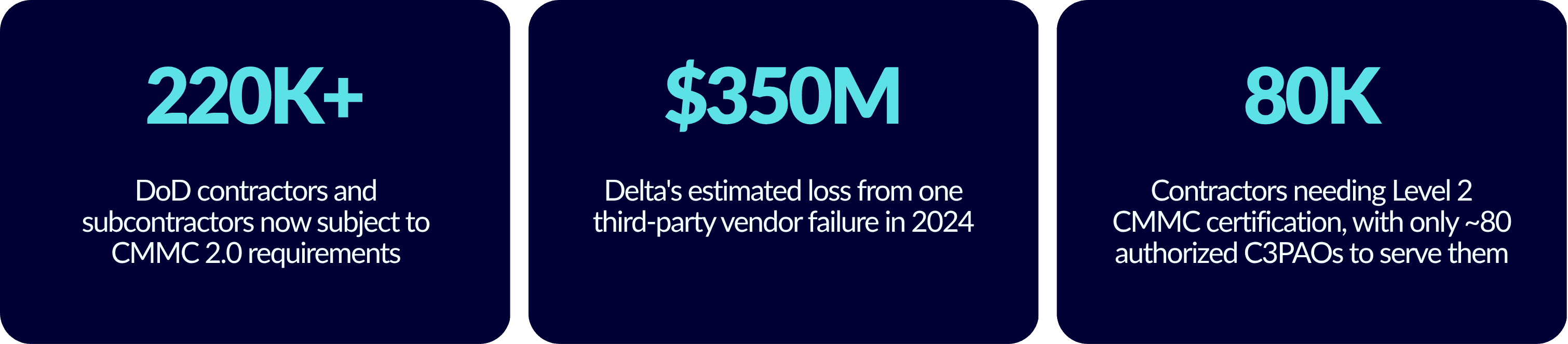
When Delta Air Lines' crew-tracking software failed during the 2024 CrowdStrike outage, the airline absorbed an estimated $350 million in losses roughly 7% of its annual net income from a single third-party failure. The Department of Transportation launched an investigation. Delta didn't write the software. But Delta paid the price.
That dynamic your vendor's vulnerability becomes your exposure is no longer an edge case. It is the defining risk pattern of the current era. Supply chain attacks, AI-powered vendor impersonation schemes, and cascading "nth-party" failures (your vendor's vendor's vendor) are now routine business risks, not theoretical scenarios.
For US businesses in 2026, the regulatory environment has also hardened significantly. CMMC 2.0 enforcement began in November 2025 for DoD contractors. The SEC's cybersecurity disclosure rules require public companies to report material vendor incidents. And regulators across banking, healthcare, and federal contracting sectors have made it explicit: the primary organization is accountable for vendor non-compliance, not just its own.
Third-party risk management is no longer a compliance checkbox managed by a single analyst with a spreadsheet. In 2026, it is a structured, technology-enabled program and organizations that treat it otherwise are accumulating unpriced risk on their balance sheets.
What Is Third-Party Risk Management (TPRM)?
Third-party risk management is the program of policies, processes, and tooling an organization uses to identify, assess, monitor, and respond to risks created by external parties it relies on. "Third party" covers far more than traditional vendors. It includes:
SaaS and cloud service providers with access to your data
IT and managed security service providers
Data processors, payment processors, and analytics platforms
Outsourced HR, legal, finance, and operational functions
Staffing agencies, consultants, and system integrators
Sub-processors the vendors your vendors rely on (fourth-party risk)
A mature TPRM program isn't built once and left alone. It governs the entire vendor lifecycle: from intake and due diligence, through contract negotiation and onboarding, to continuous monitoring, periodic reassessment, and eventual offboarding.

Best TPRM Frameworks in 2026
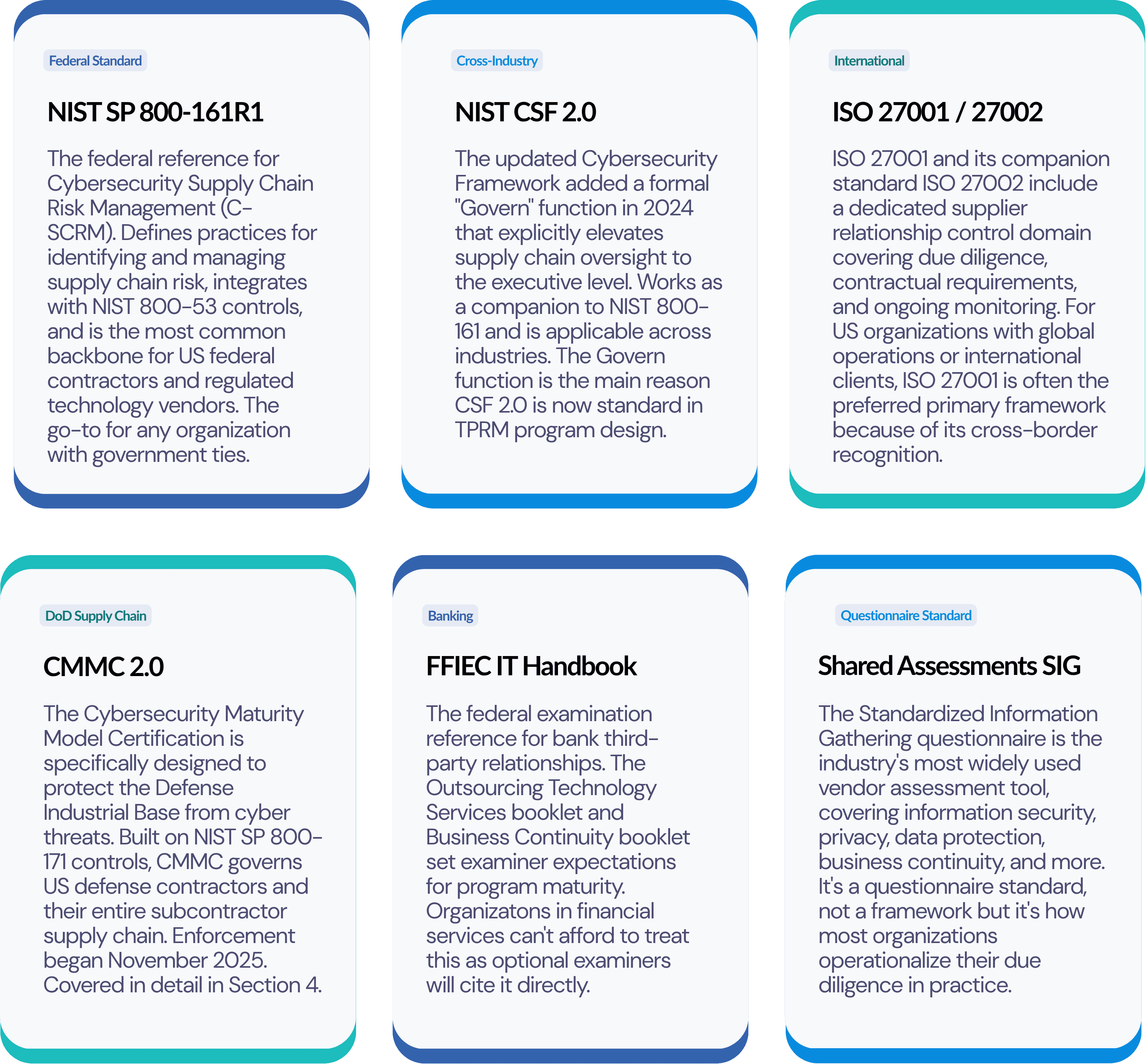
No single framework covers everything. Mature programs typically layer two to three frameworks together: a primary control framework, a sector-specific regulatory reference, and a questionnaire standard. Here are the frameworks that define best practice for US businesses today.

How to Conduct a Vendor Risk Assessment
A vendor risk assessment is the structured process of evaluating the cybersecurity, operational, compliance, and business continuity risks posed by a specific third party. Here is how well-run programs approach this today.
Step 1: Risk-Based Tiering
Not every vendor deserves equal scrutiny. Tier vendors based on factors like data access level, system integration depth, geographic footprint, and criticality to operations. Vendors with access to sensitive customer data or core systems warrant full due diligence. A supplier of office furniture does not. This tiering decision drives everything downstream assessment depth, reassessment frequency, and contractual requirements.
Step 2: Initial Due Diligence
For Tier 1 and Tier 2 vendors, due diligence should include a security questionnaire (mapped to SIG, NIST CSF, or an equivalent standard), review of certifications (SOC 2 Type II, ISO 27001, HIPAA attestations), a review of sub-processors and fourth-party relationships, and where possible, an independent outside-in assessment of the vendor's external security posture.
Step 3: Contract and Onboarding Controls
Risk findings from due diligence must translate into contractual obligations not just a filed report. Key contractual elements include security and compliance clauses, data processing agreements, audit rights, breach notification timelines, and SLAs tied to remediation of identified gaps. This is where many programs fall short: the questionnaire is completed but the findings never reach the contract.
Step 4: Continuous Monitoring
Point-in-time assessments are a starting point, not an end state. Vendor risk profiles change continuously new vulnerabilities are disclosed, certifications expire, and business circumstances shift. Continuous monitoring using external signals (security ratings, dark web monitoring, threat intelligence feeds) gives security teams real-time visibility between formal reassessment cycles.
Step 5: Offboarding and Termination
A surprisingly overlooked risk stage. When a vendor relationship ends, data deletion requirements, credential revocation, and system access removal must be formally verified and documented. Auditors will ask for offboarding records. Most organizations cannot produce them.

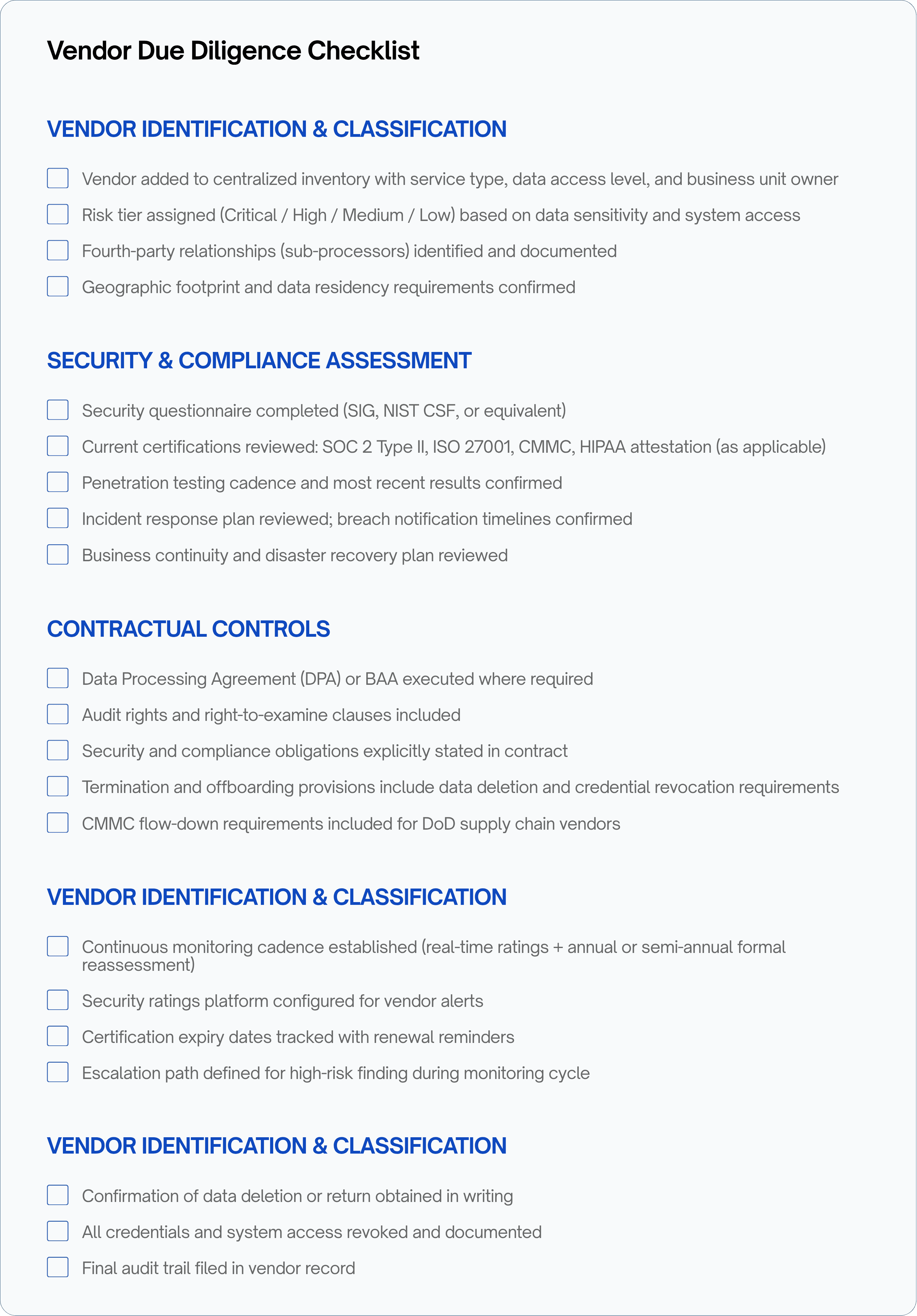
Supply Chain Due Diligence Checklist
Use this checklist to structure due diligence for Tier 1 and Tier 2 vendors. Adapt depth by tier not every item applies to every vendor relationship.
AI-Powered TPRM: Platforms, Tools, and What to Watch
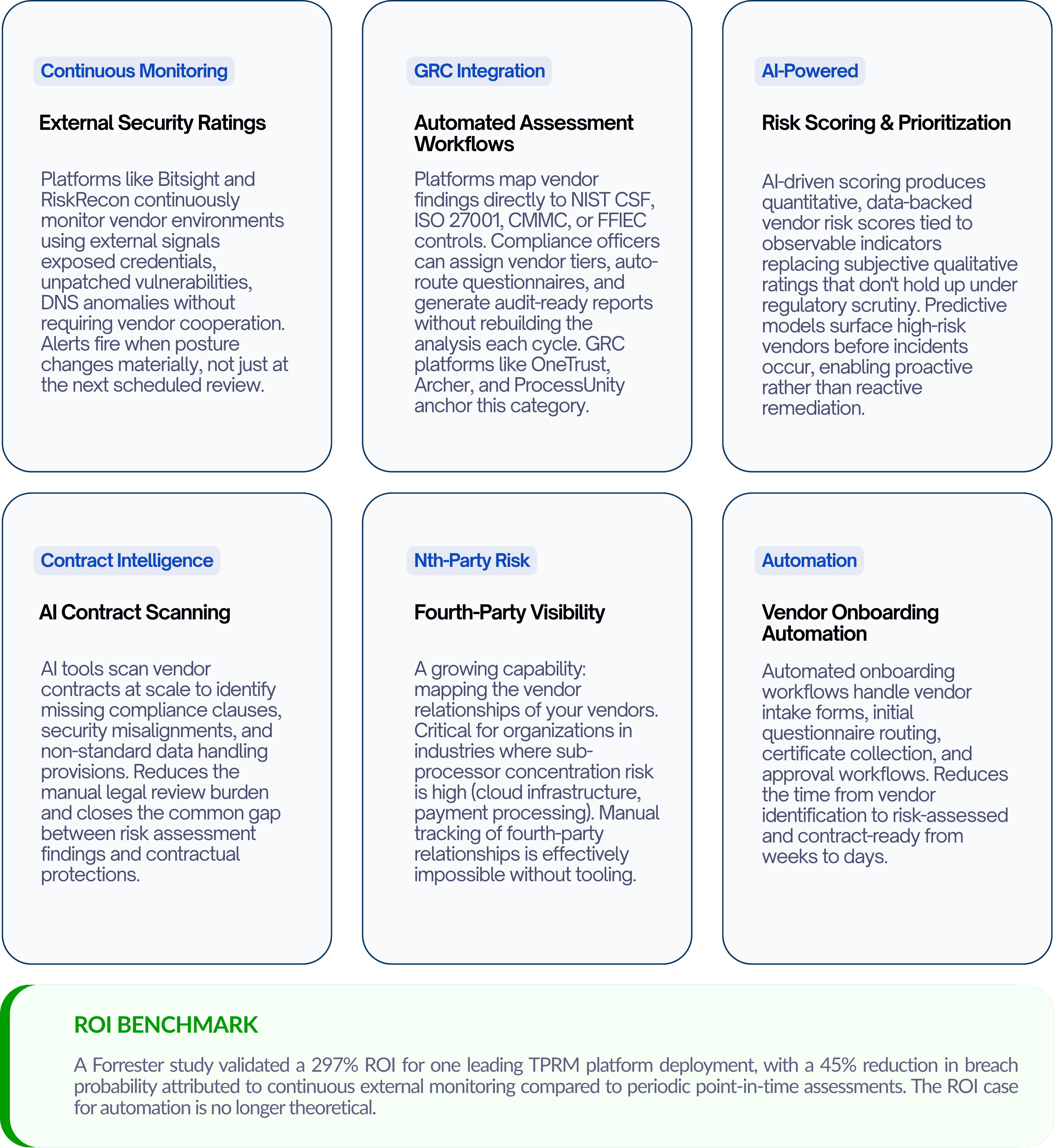
The single most significant shift in TPRM over the past two years is the transition from manual, periodic, questionnaire-based assessments to continuous, automated, AI-assisted monitoring. The volume of vendor relationships most organizations now manage often hundreds to thousands of third parties has made the old approach untenable at scale.
Agentic AI systems composed of specialized agents can now autonomously handle tasks like vendor data ingestion, initial risk scoring, anomaly detection, questionnaire routing, and report generation. This doesn't replace human judgment on high-risk decisions but it dramatically compresses the manual effort required to maintain situational awareness across a large vendor portfolio.
Leading TPRM Platform Capabilities in 2026
Integration Challenges (and How to Solve Them)
Knowing what to build and actually building it are different problems. Here are the three most common friction points in TPRM program implementation and what mature programs do about them.
Challenge 1: Siloed Ownership Across Teams
When security, legal, procurement, and business units each manage vendor relationships independently, the result is duplicate assessments, coverage gaps, and inconsistent standards. A vendor assessed by the IT team may never receive a privacy or contractual review from legal. Risk slips through the cracks between departments.
The fix: A cross-functional steering committee with representatives from security, legal, procurement, compliance, and business units plus executive sponsorship that carries budget authority. Centralize all vendor records in a single platform. Standardize assessment templates so everyone starts from the same baseline, regardless of department.
Challenge 2: Manual Processes at Scale
Spreadsheet-based TPRM programs consistently produce slower risk identification and higher assessment error rates. As vendor portfolios grow to hundreds or thousands of third parties, manual processes become not just inefficient but operationally dangerous key risk signals get buried in backlog.
The fix: Automate the repeatable. Vendor intake, certificate tracking, questionnaire routing, reminder workflows, and standard reporting can all be systematized. Reserve analyst time for high-priority risk decisions and escalations, not administrative follow-up.
Challenge 3: The Between-Assessment Gap
Annual vendor assessments leave a 364-day window where a vendor's security posture can deteriorate substantially and you won't know until the next review cycle. High-profile supply chain incidents often exploit exactly this gap: the breach occurs long before the next scheduled assessment would have surfaced it.
The fix: Layer continuous monitoring on top of periodic formal assessments. External security ratings platforms provide real-time posture signals between review cycles. Set automated alerts for material score changes, new high-severity CVEs in vendor environments, or credential exposure events on dark web sources.

Your TPRM Starting Point
Whether you're building a TPRM program from the ground up or maturing an existing one, the entry points are the same: know your vendors, know your frameworks, and close the gap between assessment and action.
For US businesses in 2026, the regulatory baseline has shifted. CMMC 2.0 is live. The SEC cybersecurity disclosure rules are in force. Banking regulators are examining continuous monitoring as a first-class requirement. Third-party risk is no longer a program you build when you have time it is a prerequisite for operating in regulated markets.
For organizations in the defense supply chain, the CMMC clock is running. Phase 2 begins in November 2026, bringing mandatory third-party assessments for Level 2 contracts. With assessor capacity severely constrained, organizations not already in the assessment pipeline face real risk of contract ineligibility.
For everyone else, the SolarWinds and CrowdStrike incidents set the standard for what "adequate" vendor oversight looks like in the eyes of regulators, insurers, and boards. Spreadsheets and annual questionnaires no longer clear the bar.
The good news: the frameworks are clear, the tooling has matured, and the ROI case for automation is proven. The program is buildable with the right foundation.
FAQ